
Have insights to contribute to our blog? Share them with a click.
Your IT Operations Team Is Running Blind on the Metrics That Regulators Actually Check
Most APAC banks we engage with have invested seriously in monitoring. Dashboards are live. Incident tickets are being raised. SLAs are being tracked. On paper, the IT operations function looks mature.
Then a MAS TRM or BNM RMiT review lands, and the first question the regulator asks is not about uptime. It is about evidence.
Specifically: can you produce a structured, query able, tamper-evident record of what your systems detected, when your team knew about it, and what action was taken?
That is a different question entirely. And most banks cannot answer it.
1.1 Why More Data Doesn't Always Create Better Visibility?
The instinct when facing a regulatory gap is to add more monitoring. More dashboards. More alert coverage. More tools tracking more metrics.
But regulators under MAS TRM Section 14 and BNM RMiT are not asking to see your dashboards. Dashboards are a present-tense view.
Regulators want a past-tense record, one that can be queried for a specific 14-day window from three months ago and returned in minutes, not reconstructed manually over three days.
More monitoring data without a structured retention and evidence architecture does not close a compliance gap. It creates more unstructured data that is harder to retrieve under audit pressure.
1.2 What High-Quality Operational Signals Actually Look Like?
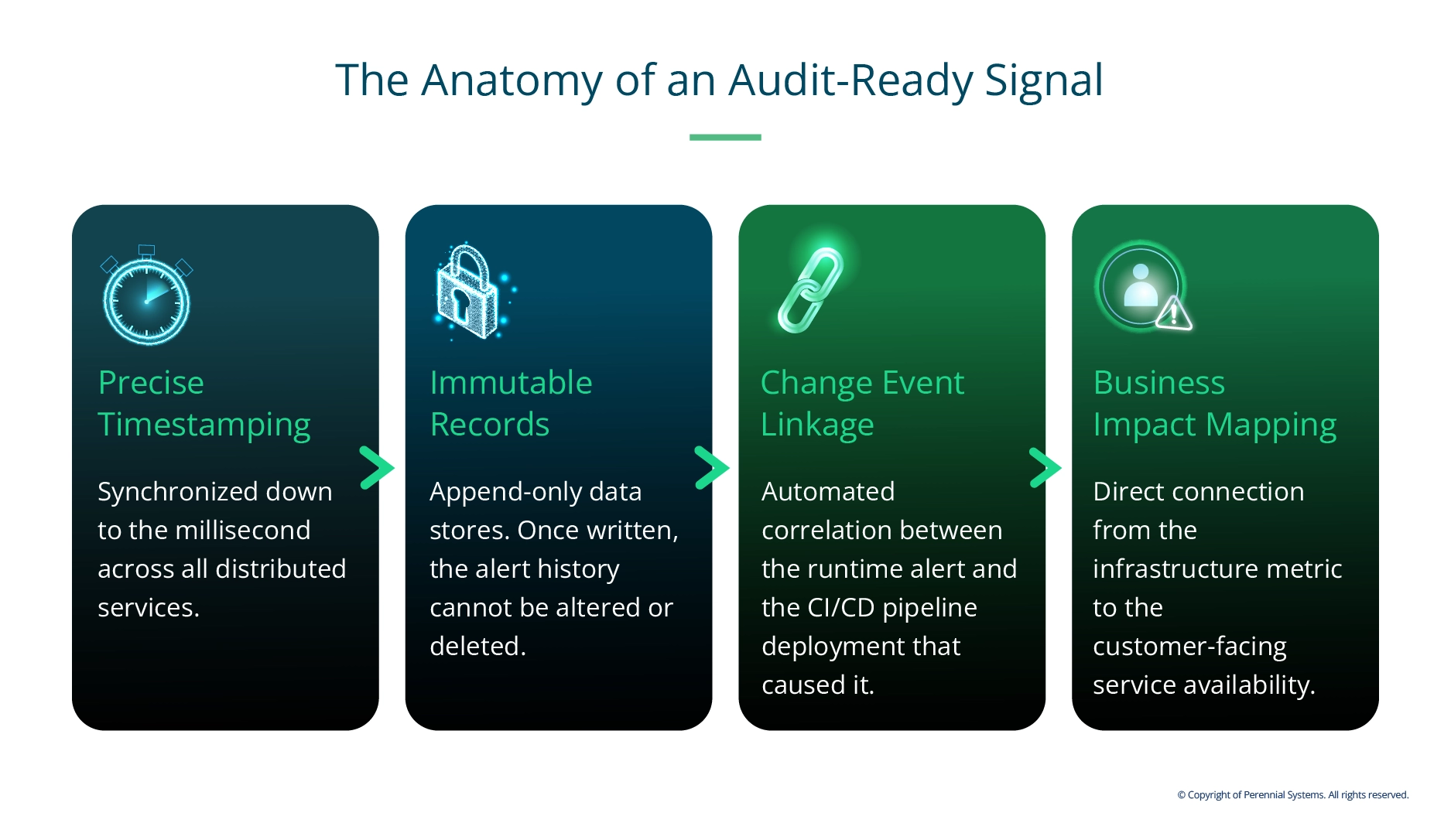
Under MAS TRM and BNM RMiT, high-quality operational signals are not defined by volume or dashboard coverage.
They are defined by four properties: they are timestamped precisely, they are immutable once written, they are linked to the change event or deployment that caused them, and they are connected to a business impact metric that tells the regulator whether a customer was affected.
Most IT operations environments satisfy none of these four requirements by default. Alert events are written to mutable logs. Change events from CI/CD pipelines are stored separately from runtime telemetry.
Incident timelines exist only in ITSM tickets, disconnected from the underlying signal data. And there is no automated link between an IT alert and whether a payment success rate or session availability metric moved in the same window.
Each of those gaps is a finding waiting to happen.
1.3 The Missing Data Layer in Most AIOps Strategies
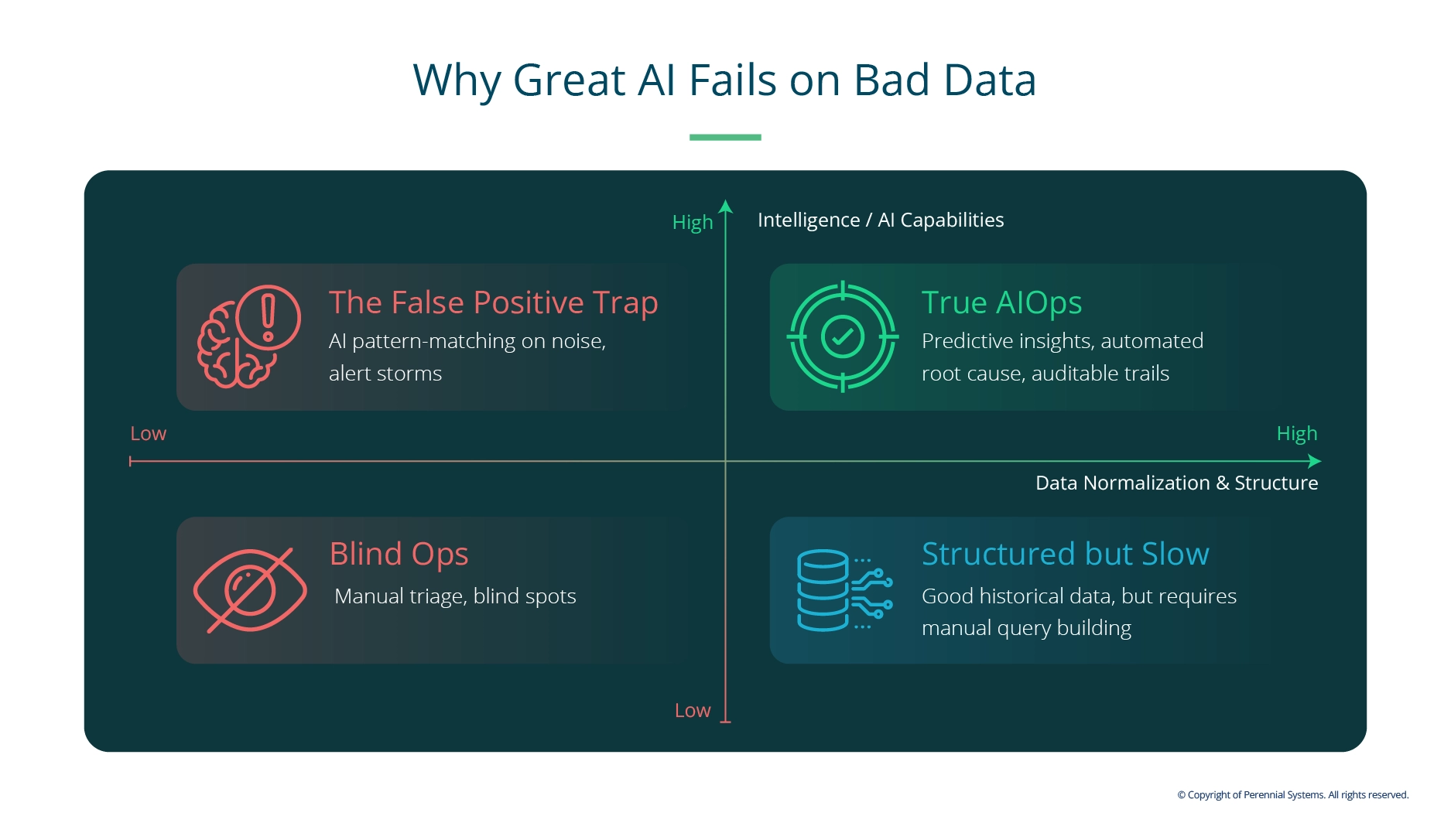
The compliance gap in most BFSI IT operations environments is not a policy gap. The policies exist. The gap is architectural.
What is missing is a data layer that sits between the monitoring tools and the compliance function, one that ingests alert and incident data into an append-only, cryptographically verifiable store, correlates it with deployment and change events in real time, links each incident to a business impact assessment automatically, and produces a signed evidence package on a defined schedule without anyone having to manually compile it.
This layer does not replace the monitoring stack. It sits beneath it and makes its output auditable. Without it, every regulatory review becomes a manual reconstruction exercise under time pressure, which is exactly the environment where errors and omissions occur.
1.4 Where AI and ML Deliver Real Operational Value?
When the evidence and correlation layer is in place, AI and ML stop being a reporting liability and start being a compliance asset.
Automated anomaly detection with a query able audit trail means the regulator can see not just that an incident occurred, but that the system detected it within the required window and that the response followed documented procedure. ML-based root cause suggestion with logged confidence scores creates a defensible record of how triage decisions were made. And predictive capacity monitoring with retained output gives the institution evidence of proactive risk management, which regulators across MAS, BNM, and APRA increasingly expect to see, not just reactive incident response.
The institutions that perform best under regulatory review are not those with the most monitoring coverage. They are the ones whose IT operations data is structured, retained, and retrievable by design.
1.5 Use the AIOps Scorecard to map your compliance gaps before your auditor does
If your current IT operations stack cannot produce a structured, query able evidence trail for a specific historical window within minutes, you are carrying regulatory risk that does not appear on any dashboard.
The BFSI AIOps Scorecard Assessment includes a dedicated compliance and audit-readiness dimension mapped directly to MAS TRM, BNM RMiT, and APRA CPS 234 requirements. It benchmarks your environment across ten operational dimensions and identifies the specific architectural gaps that create audit exposure.
Take the Scorecard or book a pre-audit observability architecture review with our engineering team.
Acknowledgments
This article was shaped through engineering insight, strategic thinking, and real-world AIOps implementation experience.
Author
Nilesh Bafna
Nilesh brings deep technical expertise in AI infrastructure and enterprise observability, grounding this piece in the architectural realities that BFSI engineering teams face every day.
Contributor
Sahil Mahalley
Sahil contributed to the article by helping frame the core narrative, ensuring the key ideas around signal fragmentation and data-layer remediation were structured clearly and compellingly.
Design & Visuals
Shriram Pathak
Shriram translated operational complexity into intuitive visuals that simplify architecture, telemetry, and correlation workflows.
Tech Partners
Ruchil Shah & Varsha Shinde
Ruchil and Varsha brought technical depth and implementation perspective, grounding the guide in scalable engineering and operational practices.
Web & Digital Experience
Javed Tamboli
Javed crafted the digital experience, ensuring the guide feels seamless, polished, and easy to navigate across platforms.


Nilesh Bafna
About the Author
I'm Nilesh, CTO at Perennial Systems. Over 20 years across UAE, India, and the Maldives have taught me one thing: most technology transformations don't fail because of bad strategy. They fail because the fundamentals weren't right to begin with.
I build large-scale solutions on Cloud, DevOps, and AI platforms. Right now, a big part of my focus is Agentic AI, getting automation out of the boardroom and into production, where it actually does something useful.
I write for technology leaders who are in the middle of making hard decisions and want a straight perspective from someone who has been in the same room.
Off the clock? Still thinking about infrastructure. Some habits don't switch off.
Have insights to contribute to our blog? Share them with a click.
0 comments